Thomas Merton
1915–1968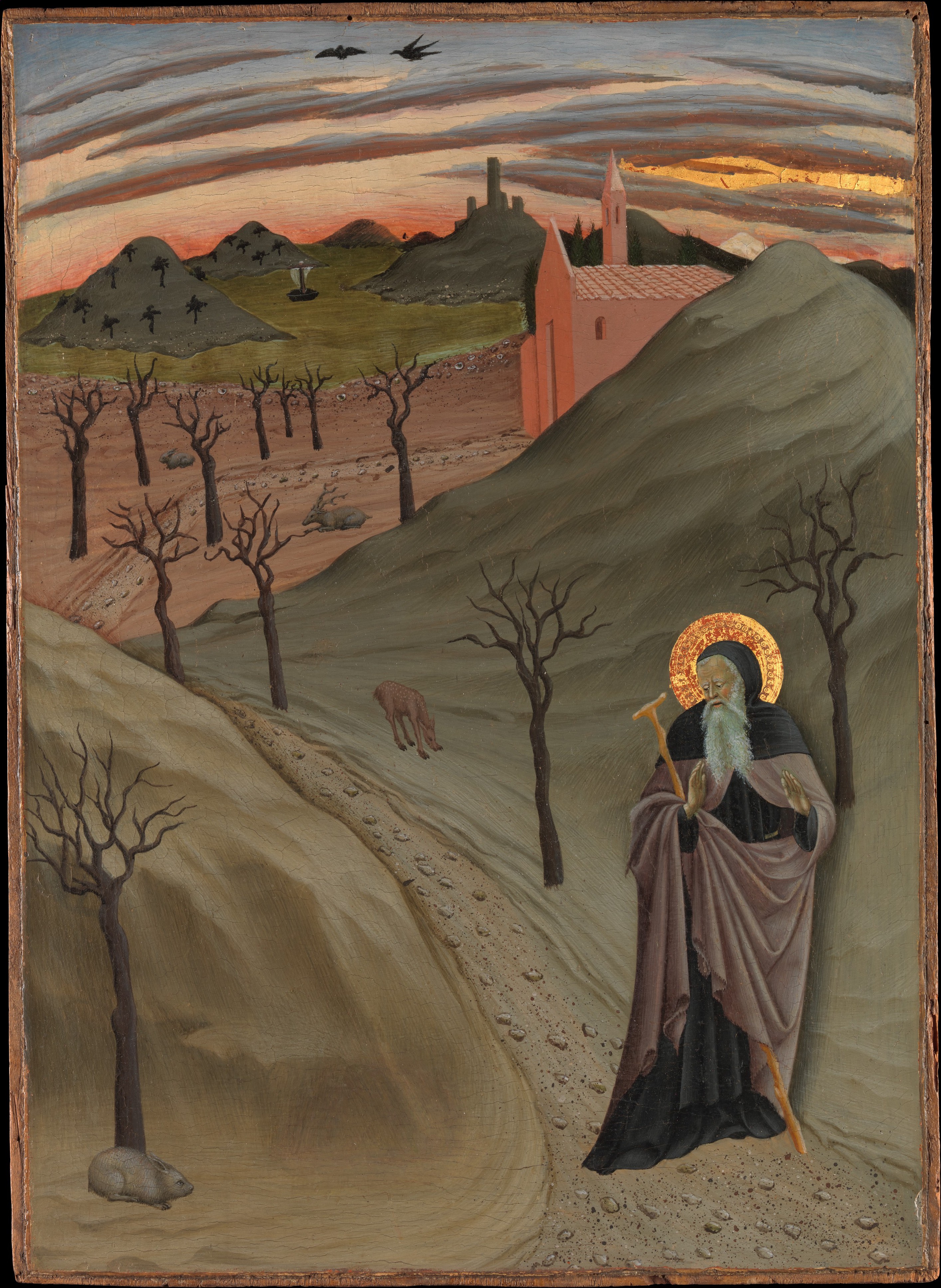
Merton, who died after getting out of the bath and touching a faulty electric fan during a monastic conference in Thailand, explored the overlap of Eastern and Western monasticism more directly in Zen and the Birds of Appetite, his collection of essays about Zen Buddhism and his dialogue with D.T. Suzuki, the post-war world’s great explainer of Zen (as Merton was of Catholicism). The essays, heady and theological, are sometimes quick to point out the insurmountable differences between the two religions, but the more I read, the less I was convinced. Instead, I was reminded of a line I’ve likely misattributed to Jacques Ellul: all religions are scaffolding around the ineffable. Perhaps I’m naive in that way. But reading Meister Eckhart quoted in Zen and the Birds of Appetite, or the poems of St. John of the Cross, who was imprisoned and tortured by his own religious order, or Wang Wei, who lived on the other side of the world eight centuries earlier, I see different fingers pointing toward the same moon.
The tree on the mountain height is its own enemy.
The grease that feeds the light devours itself.
The cinnamon tree is edible: so it is cut down!
The lacquer tree is profitable: they maim it.
Every man knows how useful it is to be useful.
No one seems to know how useful it is to be useless.
With wood from a hundred-year-old tree
They make sacrificial vessels,
Covered with green and yellow designs.
The wood that was cut away
Lies unused in the ditch.
If we compare the sacrificial vessels with the wood in the ditch
We find them to differ in appearance:
One is more beautiful than the other
Yet they are equal in this: both have lost their original nature.
So if you compare the robber and the respectable citizen
You find that one is, indeed, more respectable than the other:
Yet they agree in this: they have both lost
The original simplicity of man.
How did they lose it? Here are the five ways:
Love of colors bewilders the eye
And it fails to see right.
Love of harmonies bewitches the ear
And it loses its true hearing.
Love of perfumes
Fills the head with dizziness.
Love of flavors
Ruins the taste.
Desires unsettle the heart
Until the original nature runs amok.
These five are enemies of true life.
Yet these are what “men of discernment” claim to live for.
They are not what I live for:
If this is life, then pigeons in a cage
Have found happiness!
When an archer is shooting for nothing
He has all his skill.
If he shoots for a brass buckle
He is already nervous.
If he shoots for a prize of gold
He goes blind.
Or sees two targets—
He is out of his mind!
His skill has not changed. But the prize
Divides him. He cares.
He thinks more of winning
Than of shooting—
And the need to win
Drains him of power.
If a man steps on a stranger’s foot
In the marketplace,
He makes a polite apology
And offers an explanation
(“This place is so terribly
Crowded!”).
If an elder brother
Steps on his younger brother’s foot,
He says, “Sorry!”
And that is that.
If a parent
Treads on his child’s foot,
Nothing is said at all.
The greatest politeness
Is free of all formality.
Perfect conduct
Is free of concern.
Perfect wisdom
Is unplanned.
Perfect love
Is without demonstrations.
Perfect sincerity offers
No guarantee.
V
Abbot Pastor said: There are two things which a monk ought to hate above all, for by hating them he can become free in this world. And a brother asked: What are these things? The elder replied: An easy life and vain glory.
* XXI
A monk ran into a party of handmaids of the Lord on a certain journey. Seeing them he left the road and gave them a wide berth. But the Abbess said to him: If you were a perfect monk, you would not have even looked close enough to see that we were women.
* LIX
There was a certain brother who was praised by all the others in the presence of Abbot Anthony, but when the elder tested him he found that he could not bear to be insulted. Then Abbot Anthony said: You, brother, are like a house with a big strong gate, that is freely entered by robbers through all the windows.
* CXXIX
One of the elders said: Either fly as far as you can from men, or else, laughing at the world and the men who are in it, make yourself a fool in many things.
* CXXXII
Blessed Macarius said: This is the truth, if a monk regards contempt as praise, poverty as riches, and hunger as feast, he will never die.
If it is the case that a man is emptied of things, creatures, himself and God, and if still God could find a place in him to act, then we say: as long as that (place) exists, this man is not poor with the most intimate poverty. For God does not intend that man shall have a place reserved for him to work in, since the true poverty of spirit requires that man shall be emptied of God and all his works, so that if God wants to act in the soul, he himself must be the place in which he acts—and that he would like to do. For if God once found a person as poor as this, he would take the responsibility of his own action and would himself be the scene of action, for God is the one who acts within himself. It is here, in this poverty, that man regains the eternal being that once he was, now is, and evermore shall be.
How well I know that flowing spring in black of night.
The eternal fountain is unseen.
How well I know where she has been in black of night.
I do not know her origin.
None. Yet in her all things begin in black of night.
I know that nothing is so fair
and earth and firmament drink there in black of night.
I know that none can wade inside
to find her bright bottomless tide in black of night.
Her shining never has a blur;
I know that all light comes from her in black of night.
I know her streams converge and swell
and nourish people, skies and hell in black of night.
The stream whose birth is in this source
I know has a gigantic force in black of night.
The stream from but these two proceeds
yet neither one, I know, precedes in black of night.
The eternal fountain is unseen
in living bread that gives us being in black of night.
She calls on all mankind to start
to drink her water, though in dark, for black of night.
O living fountain that I crave,
in bread of life I see her flame in black of night.